How Does a Ratcheting Wrench Work?
A ratcheting wrench turns a fastener on its drive stroke, then lets you reset the handle without removing the wrench. A small internal gear and pawl create that one-way action.
On this page (8 sections)
- How does a ratcheting wrench work?
- What happens during each stroke?
- Why does a ratcheting wrench help in tight spaces?
- How do you use a ratcheting wrench safely?
- When should you choose a flex head?
- How is a ratcheting wrench different from a socket ratchet?
- Which ratcheting wrench set fits your work?
- What should you remember about how a ratcheting wrench works?
A ratcheting wrench turns a fastener on its drive stroke, then lets you reset the handle without removing the wrench. A small internal gear and pawl create that one-way action.
That saves time when a nearby surface limits how far you can swing a regular wrench. The wrench still needs to fit the fastener fully, and the return stroke must have enough room to click back.
How does a ratcheting wrench work?
A gear and pawl let the box end turn the fastener one way and freewheel the other way. The gear is inside the ratcheting head, and the pawl engages its teeth to drive the fastener when you push or pull the handle in the selected direction.
As you return the handle, the pawl slips over the gear teeth. You hear or feel clicks, and the fastener stays in place while the wrench resets for another turn.
A ratcheting combination wrench pairs this box end with a standard open end. The open end can help start a fastener where the box end won't fit over it, while the ratcheting end lets you keep the wrench in place as you turn.
What happens during each stroke?
The drive stroke moves the fastener; the return stroke repositions the handle. Once the wrench is seated, you move the handle through its available arc, then reverse the motion to reset it.
- Place the box end squarely over the fastener.
- Turn the handle in the direction that tightens or loosens it.
- Reverse the handle to let the ratchet reset.
- Repeat until you need to reposition or remove the wrench.
The size of the needed swing depends on the wrench's gear design. For example, GEARWRENCH describes its ratcheting box end as needing as little as 5 degrees of movement, compared with 30 degrees for a standard wrench.
Its size markings are stamped on both ends of the beam. Check the fastener size before turning, since a wrench that is too large can slip and round the corners.
Why does a ratcheting wrench help in tight spaces?
It helps when you can fit the head onto a fastener but cannot swing a standard wrench through a wide arc. The handle can make repeated short turns without coming off the fastener after every stroke.
A compact swing is especially useful near brackets, pipes, or panels. It doesn't make every narrow space reachable: the head and handle still need room, and a socket with an extension may fit better when the fastener sits deep inside a recess.
The CRAFTSMAN 20-piece set has a 90-tooth box end with a stated 4-degree arc swing. Its 12-point box end is designed for quick engagement, and the set includes both SAE and metric sizes.
Use the open end to start a fastener if the box end cannot pass over it, then switch to the ratcheting end once it is positioned. For socket-based work, our guide to how socket sizes are measured explains how to match a socket to a fastener.
How do you use a ratcheting wrench safely?
Seat the correct size fully and keep the wrench aligned with the fastener. Apply smooth pressure through the handle rather than jerking it or pushing at an angle.
Check which direction engages the drive before applying force. Some ratcheting wrenches have a direction selector, while others require you to flip the wrench over.
Don't use a ratcheting wrench as a breaker bar for a seized fastener. A longer or higher-force tool can help loosen a stubborn bolt; see what a breaker bar is used for before choosing one.
If the wrench skips under light pressure, stop and check the size, fit, and direction. A damaged fastener or worn ratchet can also prevent a secure turn.
When should you choose a flex head?
Choose a flex head when the handle needs to angle around an obstacle. Its pivoting box end can change the handle's approach, while a fixed head holds a set angle.
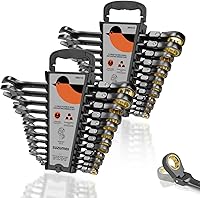
The SUZUME 24-piece set is described as having a 180-degree rotating head and a 72-tooth ratchet. It includes SAE and metric sizes, plus a storage rack.
A pivoting head adds another adjustment, but it may not fit every narrow gap. Check the head's clearance and the direction the handle needs to move before choosing it for a crowded area.
Compare the tradeoffs in flex head vs fixed head ratchets. For a broader choice between tool types, read ratchet vs wrench: when to use each one.
How is a ratcheting wrench different from a socket ratchet?
A ratcheting wrench grips the fastener with its own box end; a socket ratchet uses a separate socket on a square drive. Both let you reset the handle without removing the tool after each stroke.
A socket ratchet gives you a choice of socket sizes and can use extensions or a universal joint. A ratcheting wrench is ready to use once you select the right size, and its open end can help start a fastener that a closed box end cannot reach.
If you are working on a recessed fastener, a socket and extension may give you a better approach. Our guide to deep sockets and when to use them covers extra reach for fasteners on longer studs.
Which ratcheting wrench set fits your work?
Choose a set based on the fastener sizes you encounter and the clearance around them. A wider size range can reduce gaps, while a pivoting head can help when the handle needs to approach at an angle.
The GEARWRENCH set includes 30 SAE and metric wrenches, with a thin head and beam. CRAFTSMAN's 20-piece set offers a stated 4-degree arc swing, while SUZUME's 24-piece set has a 180-degree flex head.
For more options, see our best ratcheting wrench sets. If you need both open-end and box-end tools without a ratcheting mechanism, compare combination wrench sets.
What should you remember about how a ratcheting wrench works?
A ratcheting wrench drives a fastener on one stroke and clicks back on the other, so you can make repeated turns without lifting the wrench each time. Pick the correct size, keep the head seated, and use another tool to break loose a fastener that needs more force.
Choose a flex head if handle angle is the main problem. Choose a fixed head when its angle fits the space, and a socket ratchet when interchangeable sockets or extensions would help.
Frequently asked questions
How does a ratcheting wrench turn a bolt?
The box end grips the fastener while an internal gear and pawl let the wrench turn in one direction. On the return stroke, the mechanism clicks and the handle moves back without turning the fastener, so you can repeat the drive stroke without lifting the wrench off.
Which way should a ratcheting wrench face?
Set the wrench so its drive stroke turns the fastener in the direction you need, usually clockwise to tighten and counterclockwise to loosen a standard right-hand thread. If it slips on the return stroke or turns the wrong way, flip the wrench or move its selector if it has one.
Can you loosen a tight bolt with a ratcheting wrench?
A ratcheting wrench can loosen a bolt if the fastener is not seized and the wrench fits securely. For a very tight bolt, use a tool intended for breaking it loose, then switch to the ratcheting wrench once it moves; avoid forcing a small wrench beyond its intended use.
What is the difference between a ratcheting wrench and a ratchet?
A ratcheting wrench has a wrench-shaped open end and a ratcheting box end, while a socket ratchet has a square drive that holds interchangeable sockets. The wrench can fit directly over a fastener head, while a ratchet gives you socket-size and extension options.