What Is a Breaker Bar and What Is It Used For?
A breaker bar is a long-handled socket tool used to loosen tight nuts and bolts. Its handle gives you more leverage than a short ratchet, while the bar's head pivots to help you position it.
On this page (9 sections)
- What is a breaker bar used for?
- How does a breaker bar work?
- How is a breaker bar different from a ratchet?
- What socket fits a breaker bar?
- Which breaker bar length should you choose?
- How do you use a breaker bar safely?
- Can an impact socket set help with breaker bar jobs?
- When should you choose a longer breaker bar?
- What should you remember about breaker bars?
A breaker bar is a long-handled socket tool used to loosen tight nuts and bolts. Its handle gives you more leverage than a short ratchet, and its pivoting head helps you position the socket around nearby parts.
Use it to break a fastener loose, then switch to a ratchet or wrench to finish turning it. A breaker bar is a manual tool, not a torque wrench, so it can't tell you when a bolt has reached a required tightness.
What is a breaker bar used for?
A breaker bar is typically used to loosen stubborn fasteners with a socket. Common jobs include loosening lug nuts before changing a tire and freeing tight bolts during car repair.
The longer handle gives you more leverage than a short ratchet. The head often pivots so you can adjust the handle angle when space around the fastener is tight.
A breaker bar helps you apply force, but it doesn't make a stuck fastener risk-free. If a bolt is corroded, damaged, or turning the wrong part with it, stop and check the repair instructions before adding more force.
How does a breaker bar work?
A breaker bar transfers force from your hand, through its handle and drive head, to a socket on the fastener. A longer handle can give you more leverage, so steady pressure may loosen a fastener that resists a short ratchet.
The socket must fit the fastener and the bar's drive size. For help identifying socket measurements, see how socket sizes are measured.
Keep the socket square on the fastener and pull with controlled pressure. Avoid jerking the handle or adding a pipe for extra length, since that can damage the tool or fastener and make you lose control.
How is a breaker bar different from a ratchet?
A breaker bar is for applying leverage to loosen a tight fastener; a ratchet is for turning a fastener through repeated strokes. Using a breaker bar for the initial loosening can spare a ratchet's internal mechanism from excessive force.
Once the fastener moves, a ratchet can turn it faster in a confined space. See breaker bar vs ratchet for more on when to use each tool.
Don't use a breaker bar to tighten a bolt to a measured specification. A torque wrench is the right tool when the repair instructions call for a specific torque.
What socket fits a breaker bar?
Choose a socket that matches both the breaker bar's drive size and the fastener. A 1/2 inch drive bar needs a 1/2 inch drive socket, but the socket's opening must also match the nut or bolt.
For lug nuts, check the vehicle manual or measure the fastener before choosing a socket. Our guide to the socket size for lug nuts explains how to find the right fit.
A deep socket can help when a nut sits on a long stud, while a shallow socket may suit a fastener with little clearance above it. Read what a deep socket is and when you need one to compare the two shapes.
Which breaker bar length should you choose?
Choose a length that gives you enough reach and leverage while leaving room to move the handle safely. Longer bars can offer more leverage, but they need more clearance and careful control.
The GEARWRENCH set includes 15 inch and 24 inch 1/2 inch drive breaker bars, each with a 180 degree flex tang and a ball detent to retain the socket.
Choose the set if having both lengths would help with different jobs. If one bar is enough, a single-length option may be simpler to store.
The Craftsman breaker bar is an 18 inch, 1/2 inch drive model with a head that rotates 180 degrees.
Pick it if you want one bar between the shorter and longer options. Check the space around the fastener before choosing a handle length.
How do you use a breaker bar safely?
Use a breaker bar with a snug-fitting socket, keep the socket fully seated, and apply steady pressure. Position your body so your hand won't strike nearby parts if the fastener releases.
Pull the handle when possible, rather than pushing toward yourself. Keep your face and hands clear of the handle's travel path, and stop if the socket begins to slip or the fastener starts to round.
Don't use a cheater pipe to extend the handle. Don't strike the bar with a hammer, and don't use it with an impact wrench.
If the fastener won't move, check for a locking clip, reverse thread, or another step in the repair instructions.
Can an impact socket set help with breaker bar jobs?
An impact socket set can help when you need a compatible socket for a manual breaker bar and also use impact tools for other work. Match the drive size and socket opening to the bar and fastener.
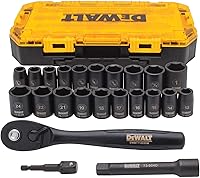
The DeWalt set has 1/2 inch drive impact sockets in SAE and metric sizes, plus an extension, drill adapter, and quick release ratchet. The sockets are impact-ready and made with heat-treated CR-440 steel.
Choose it if you need impact-rated sockets for impact-tool jobs as well as a range of 1/2 inch drive sizes. Its ratchet is useful for turning fasteners after they've loosened, but don't apply breaker-bar force through the ratchet.
When should you choose a longer breaker bar?
A longer bar may suit a fastener that needs more leverage, provided you can move the handle without hitting surrounding parts. The NEIKO bar measures 24 inches, has a 180 degree flex head, and uses a ball detent to hold 1/2 inch drive sockets.
Choose it when its extra length fits the workspace and the job. If the handle can't travel safely, a shorter tool or another approach may be a better fit.
Avoid treating length as permission to force a fastener. Stop if you see the socket twisting, the head shifting, or the fastener beginning to deform.
What should you remember about breaker bars?
A breaker bar is for loosening tight fasteners with a well-fitting socket. Match its drive size to the socket, use controlled pressure, and switch to a ratchet once the fastener breaks loose.
Choose a shorter bar for limited clearance and a longer one when you need more reach and leverage. For an overview of the tools to keep on hand, see basic tools for car repair, and use a torque wrench when a job calls for a specific tightening value.
Frequently asked questions
What is a breaker bar typically used for?
A breaker bar is typically used to loosen tight or stuck nuts and bolts with a socket. Its long handle gives you more leverage than a short ratchet, which can help with jobs such as loosening lug nuts before changing a tire.
Use steady pressure and the right socket for the fastener.
Can you use a breaker bar to tighten bolts?
A breaker bar can turn a fastener in either direction, but it isn't a torque wrench. For bolts that need a specified tightness, use a torque wrench and follow the vehicle or equipment instructions.
Don't use extra leverage to force a fastener that won't turn.
Can you use regular sockets on a breaker bar?
Use a socket with the same drive size as the breaker bar, and make sure it fits the fastener fully. For impact tools, use impact-rated sockets; ordinary chrome sockets aren't made for impact-wrench force.
A manual breaker bar doesn't make an incorrect or loose-fitting socket safe.
Is a breaker bar stronger than a ratchet?
A breaker bar is designed to apply leverage when loosening a tight fastener, while a ratchet is made for turning fasteners through repeated strokes. A ratchet's internal mechanism can be damaged by excessive force.
Use the breaker bar to loosen, then switch to a ratchet for faster turning.