Basic Tools for Car Repair: What to Own First
Start with a socket set, combination wrenches, screwdrivers, pliers, and safety gear. Add a jack and stands only for jobs that require lifting, and buy specialty tools when a specific repair calls for them.
On this page (7 sections)
- What basic tools for car repair should you own first?
- Do you need a small kit or a larger mechanics set?
- What tools help you loosen and tighten fasteners?
- When should you add impact sockets?
- What equipment do you need before lifting a car?
- Which tools can wait until you choose a repair?
- How should you build your home car repair kit?
Start with a socket set, combination wrenches, screwdrivers, pliers, and safety gear. Add lifting equipment only for jobs that require it, and buy specialty tools when a repair calls for them.
A small, well-chosen kit can handle common tasks such as checking a battery, changing a wiper, or removing accessible fasteners. Your car's service manual should guide any job that involves lifting, torque values, fluids, brakes, or electrical systems.
What basic tools for car repair should you own first?
A socket set and combination wrenches cover many everyday fasteners. Add screwdrivers, pliers, a flashlight, safety glasses, and a torque wrench for jobs with specified tightening values.
A socket set gives you sockets and a ratchet to turn matching nuts and bolts. Check whether it includes both SAE and metric sizes, which drive sizes it covers, and whether its case keeps tools organized.
A wrench set complements sockets when a ratchet cannot fit around the fastener. The HORUSDY set includes 32 combination wrenches in SAE and metric sizes, with a storage case.
Round out the kit with a flathead and Phillips screwdriver, slip-joint pliers, needle-nose pliers, and a flashlight. Keep safety glasses close by, and wear gloves appropriate to the work.
Do you need a small kit or a larger mechanics set?
Choose a small kit if you know which jobs you plan to do. A larger set makes sense when its extra tools and storage match several repairs you expect to handle.
The DeWalt kit is a focused starting point with 1/4 in and 3/8 in drive tools. It includes two pear-head ratchets, sockets, extensions, and adapters.
For a broader collection, the Craftsman set contains 230 pieces, including sockets, 3 ratchets, 21 wrenches, hex keys, specialty bits, and accessories. Its tools come in a 3-drawer kit with a one-handed locking dial.
Before choosing, compare the set's included sizes and pieces against your planned jobs. A high piece count alone doesn't tell you whether the tools you need are included.
What tools help you loosen and tighten fasteners?
Use the tool that fits the fastener and the space around it. A socket and ratchet are efficient when they fit, while a combination wrench can reach fasteners that are blocked from the side.
Start by checking how socket sizes are measured in our guide to how socket sizes are measured. If you need extra reach over a long stud, see what a deep socket is and when to use one.
For a stuck fastener, use penetrating oil when appropriate and allow it time to work. A breaker bar can provide leverage, but it isn't a substitute for choosing the correct socket or loosening method; see what a breaker bar is used for.
A torque wrench serves a different purpose. Use it where the repair instructions give a torque value, and follow the wrench maker's directions for setting and using it.
When should you add impact sockets?
Add impact sockets if you use an impact wrench or another impact tool that requires them. They are intended for impact use, while ordinary hand sockets are not a safe substitute.
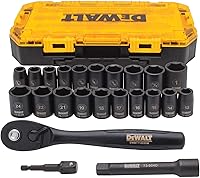
The DeWalt 23-piece set is a 1/2 in drive impact socket set with SAE and metric sockets, an extension, a drill adapter, and a quick-release ratchet. Its sockets are described as impact-ready and made with heat-treated CR-440 steel.
Use an impact socket only with compatible equipment and the tool maker's instructions. If you work by hand, a regular socket set is a more direct first purchase.
For wheel work, identify the correct socket size before starting. Our guide to the socket size for lug nuts explains what to check.
What equipment do you need before lifting a car?
Use a jack and correctly rated jack stands for work under a raised car. Follow the vehicle manual for approved lift points and the stand setup, and never work beneath a vehicle held only by a jack.
Choose a firm, level surface and secure the vehicle as the manual directs. Keep people clear of the work area while lifting and lowering.
A wheel chock can help prevent movement when used as directed. Don't improvise with bricks, loose blocks, or other supports that aren't designed for the load.
If you don't have the right lifting equipment or can't identify the approved support points, choose a task that keeps the vehicle on the ground or get help from a qualified mechanic.
Which tools can wait until you choose a repair?
Wait on specialty tools until a planned repair requires them. This keeps your first kit focused and helps prevent buying equipment that doesn't fit your vehicle or task.
A brake job may call for tools beyond basic sockets and wrenches. Review the tools needed to change brakes at home before deciding whether the job is within your equipment and experience.
Battery work can have its own requirements, so check the tools needed to change a car battery before disconnecting anything. For oil changes, confirm the drain plug size and the service instructions; our guide to the wrench size for an oil drain plug can help with that check.
How should you build your home car repair kit?
Buy the basics around the jobs you can identify, then fill gaps as they come up. For most beginners, that means a socket set, a combination wrench set, screwdrivers, pliers, a flashlight, eye protection, and a torque wrench when required.
Choose the DeWalt 108-piece kit if you want a smaller collection of sockets, ratchets, extensions, and adapters. Choose the Craftsman set if its broader mix of sockets, wrenches, bits, and storage suits your garage.
Add the HORUSDY wrench set if you need a separate SAE and metric wrench assortment. Choose the DeWalt impact sockets only when an impact tool is part of the job.
Before each repair, check the manual, confirm the tool sizes, and make sure you have the right safety equipment. Then use tools needed to change a car battery or tools needed to change brakes at home to plan the next job.
Frequently asked questions
What tools should a beginner have for car repairs?
Start with a socket and ratchet set, combination wrenches, screwdrivers, pliers, a flashlight, and safety glasses. Add a torque wrench for repairs that require a specified tightening value.
A jack and properly rated stands are needed for work beneath a raised vehicle, but aren't a substitute for the vehicle maker's lifting instructions.
Do I need both sockets and wrenches?
A basic kit benefits from both. Sockets work quickly when a fastener is reachable with a ratchet, while a wrench can fit where a socket and handle cannot.
Check whether a proposed set covers the sizes and measurement systems used by your vehicle before buying.
Should I buy a large mechanics tool set first?
A large set can cover more jobs in one purchase, but it may include tools you rarely use. Choose a compact socket set and a few essentials if you have a short task list; consider a larger set if its included wrenches, sockets, ratchets, and storage match the repairs you plan to do.
What safety equipment do I need for home car repair?
Use safety glasses and gloves suited to the task, and work on a firm, level surface with the vehicle secured according to its manual. For work underneath, use correctly rated jack stands at approved lift points.
Never rely on a hydraulic jack alone to support a vehicle.