Tools Needed to Change Brakes at Home
The tools needed to change brakes at home include a floor jack, jack stands, wheel chocks, a lug wrench, sockets, and a torque wrench. You may also need a breaker bar, a caliper piston tool, and basic safety gear, depending on your vehicle.
On this page (8 sections)
- What tools do you need to change brakes at home?
- How do you support the vehicle safely?
- Which sockets and ratchet should you use?
- When is a breaker bar useful?
- Do you need impact sockets for a brake job?
- What tool retracts the brake caliper piston?
- Which tools help you finish the job correctly?
- What should you check before starting?
The tools needed to change brakes at home include a floor jack, jack stands, wheel chocks, a lug wrench, sockets, and a torque wrench. Depending on your vehicle, you may also need a breaker bar, a caliper piston tool, and basic safety gear.
Check the service manual before buying tools or lifting the vehicle. Brake designs, fastener sizes, lift points, and torque values vary by make and model.
What tools do you need to change brakes at home?
Start with secure lifting and the correct hand tools. A basic setup includes a floor jack, jack stands rated for the vehicle, wheel chocks, a lug wrench, a socket set, and a torque wrench.
You may also need a brake caliper piston tool, a small wire brush, and a way to support the caliper after removing it. The manual should tell you which items fit your vehicle and whether the piston needs to be pushed or turned.
| Tool | Why it helps |
|---|---|
| Floor jack | Raises the vehicle at the approved lift point |
| Jack stands | Support the vehicle while you work |
| Wheel chocks | Help keep the wheels on the ground from moving |
| Lug wrench or socket | Removes and reinstalls wheel fasteners |
| Ratchet and sockets | Remove caliper and bracket fasteners |
| Torque wrench | Tightens fasteners to the specified torque |
| Breaker bar | Helps loosen tight fasteners by hand |
| Caliper piston tool | Retracts some brake caliper pistons |
| Eye protection and gloves | Help protect you from debris and grime |
Use the basic tools for car repair guide to build a general hand-tool kit. Brake work also calls for lifting and torque tools that you might not need for smaller repairs.
How do you support the vehicle safely?
Use a floor jack to lift the vehicle, then lower it onto jack stands at approved support points. Never work under a vehicle held only by a jack.
Park on a firm, level surface, apply the parking brake as directed by the manual, and chock wheels that stay on the ground. Follow the vehicle's instructions for disabling any brake or stability systems before starting.
Do not use a brick, loose wood, or a spare tire as a substitute for a jack stand. If the vehicle shifts or the support points are unclear, stop and get help from a qualified mechanic.
Which sockets and ratchet should you use?
Use sockets that fit the fasteners exactly and match your ratchet's drive size. A tight fit helps reduce the chance of rounding a fastener, while the right drive size keeps your tools compatible.
Check whether your vehicle uses metric or SAE sizes and whether any fasteners need deep sockets or an extension. Our guide to how socket sizes are measured explains the markings, and what size socket fits lug nuts covers wheel fasteners.
The TEKTON set includes 3/8 in drive 6-point shallow and deep sockets in inch and metric sizes, plus a ratchet, extensions, and a universal joint.
A larger mechanics set can cover more drive sizes and other general tasks. The DeWalt set includes 1/4, 3/8, and 1/2 in drive tools, sockets, extensions, and combination wrenches.
Neither set replaces a torque wrench. Check the vehicle manual for socket sizes and torque specifications before you begin.
When is a breaker bar useful?
A breaker bar gives you a long handle for loosening a tight fastener by hand. Use steady pressure and the correct socket, keeping the bar positioned so it cannot slip toward you.
The GEARWRENCH set includes 15 in and 24 in 1/2 in drive breaker bars, each with a flex tang. A breaker bar is for loosening, not for final tightening.
Don't use a regular ratchet as a substitute for a breaker bar when a fastener is stuck. See what a breaker bar is used for and breaker bar vs ratchet for the difference.
Do you need impact sockets for a brake job?
Impact sockets are useful if you're using an impact tool; they aren't necessary for every brake job. Match the socket type to the tool, since hand sockets and impact sockets are designed for different use.
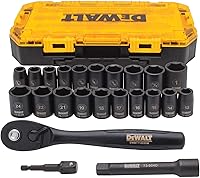
The DeWalt set includes 1/2 in drive impact sockets in SAE and metric sizes, plus an extension, drill adapter, and quick-release ratchet.
Use hand tools when the service procedure calls for controlled manual work. Don't use an impact tool to tighten wheel fasteners unless the vehicle procedure specifically permits it.
What tool retracts the brake caliper piston?
Use the piston method specified for your vehicle. Some pistons press back, while others must turn as they retract, and the wrong approach can damage brake parts.
A caliper piston tool may be needed for turning designs. Support the caliper so its weight doesn't hang from the brake hose, and follow the manual's steps for the piston, pads, and any electronic parking brake.
Don't open a brake line or disconnect a hose unless the procedure requires it and you know how to bleed the system afterward. If the piston won't move using the specified tool and method, stop rather than applying more force.
Which tools help you finish the job correctly?
A torque wrench helps you tighten fasteners to the vehicle maker's specifications. Use it for wheel fasteners and brake components where the manual provides a torque value.
A wire brush can help clean a mounting surface, while a light and inspection mirror can help you see tight areas. These are useful extras, but they don't replace the required tools or the service procedure.
Before lowering the vehicle, check that each fastener is accounted for and that the brake pedal feels firm according to the manual's procedure. If it doesn't, don't drive the vehicle.
What should you check before starting?
Confirm the vehicle's procedure, parts, sizes, and torque values before lifting it. Have all tools within reach and keep the work area clear.
Read the manual for lift points, support points, caliper removal, piston retraction, and wheel-fastener torque. If you can't confirm a safe procedure or don't have stable supports, have a professional do the work.
For related garage tasks, see tools needed to change a car battery and the guide to socket sets for home garages. Choose tools that fit your vehicle and the job, then use the manual's steps from start to finish.
Frequently asked questions
What tools do I need to change brake pads at home?
For many vehicles, you need a floor jack, jack stands, wheel chocks, a lug wrench, sockets and ratchet, and a torque wrench. The exact socket sizes and caliper tools vary by vehicle.
Check the service manual for the lift points, fastener torque, and brake procedure before starting.
Can I change brake pads without a torque wrench?
A torque wrench is the right tool for tightening wheels and brake fasteners to the vehicle maker's specifications. Guessing by feel can leave a fastener too loose or too tight.
Find the correct torque values in the service manual and use the specified tightening sequence.
Do I need a special tool to compress a brake caliper?
Some caliper pistons press straight back, while others need to turn as they retract. The required method depends on the vehicle and brake design, so check the service manual before choosing a piston tool.
Don't force a piston with pliers or a clamp if the procedure calls for rotation.
Are impact sockets required for changing brakes?
Impact sockets aren't required for every brake job, especially if you use hand tools. They are made for use with impact tools, while regular chrome sockets are intended for hand use.
Match the socket to your tool, fastener, and vehicle instructions, and use the correct drive size.