Socket Sets: The Complete Guide for Home Garages
A useful socket set for a home garage covers the fasteners you work on, with compatible drive sizes, SAE or metric measurements, and both shallow and deep sockets where needed. Start with a small hand-tool set for light repairs, then add larger drives or impact sockets for jobs that call for them.
On this page (9 sections)
- What should a home garage socket set cover?
- What do socket drive sizes mean?
- Do you need metric and SAE sockets?
- When do you need shallow or deep sockets?
- What is the difference between hand and impact sockets?
- Which other tools are useful with a socket set?
- How can you keep a socket set organized?
- How do you choose a first socket set?
- Which socket set approach fits your garage?
A useful socket set for a home garage covers the fasteners you work on, with compatible drive sizes, SAE or metric measurements, and shallow or deep sockets when needed. Start with the jobs you expect to do, then choose a set that provides those sizes and a ratchet that fits the available space.
A large piece count does not automatically make a set right for your garage. Check the drive sizes, measurement system, socket depth and storage before you buy.
This guide explains those choices, how socket sets fit common home and car jobs, and when to add specialty tools. For one example of a job-specific choice, see our guide to the socket size for lug nuts.
What should a home garage socket set cover?
Choose a set around your regular jobs and the fasteners they use. A small, well-matched set is more useful than a larger one that leaves out the sizes you need.
Start by listing the work you plan to do, such as assembling equipment, maintaining a bicycle or handling basic car repairs. Check the fasteners on that equipment when possible, and note whether they use metric or SAE sizes.
Think about access, too. A fastener in an open space may be easy to reach with a standard ratchet, while one near a recess may need a longer socket or an extension.
How do you choose a socket set for a home garage?
Choose a socket set by checking the sizes, drives and socket types you will actually use. These details matter more than a big piece count on the case.
| Check | What it tells you | What to do |
|---|---|---|
| Measurement system | Whether the sockets use metric, SAE, or both | Match it to the fasteners you plan to work on |
| Drive size | Which ratchets and accessories fit the sockets | Confirm the ratchet and sockets share a drive size |
| Socket depth | Whether the socket can reach over a longer fastener | Choose shallow, deep, or a mix for your jobs |
| Point design | How the socket contacts a fastener | Match it to the fastener and follow the tool maker’s guidance |
| Storage | How the set stays arranged between jobs | Look for a case or tray that fits your storage space |
A set with both metric and SAE sockets can cover more types of equipment. If you mostly work on one machine, you may be able to buy a smaller set after checking the sizes it uses.
The guide to measuring socket sizes explains how size labels relate to the fastener and helps you avoid confusing a socket’s drive size with its opening size.
What do socket drive sizes mean?
A socket’s drive size is the square opening that connects it to a ratchet or accessory. It is separate from the size of the fastener opening at the other end.
Common hand-tool drives include 1/4 in, 3/8 in and 1/2 in.
The smaller drive can fit into tighter spaces, while a larger drive accepts larger sockets and tools. Each socket must match the drive on the ratchet or accessory, or you need a compatible adapter.
Adapters can connect different drive sizes, but they do not change what a tool is designed to handle. Follow the tool maker’s instructions and don’t use an adapter to force a tool into a job beyond its intended use.
Which drive size is a good place to start?
A 3/8 in drive is a flexible starting point for many home hand-tool tasks, but the right choice depends on the fasteners and access in your work. A set with both 1/4 in and 3/8 in drives can cover a wider range of smaller and medium tasks.
| Drive | Consider it for | Check before choosing |
|---|---|---|
| 1/4 in | Smaller sockets and restricted access | Whether the sockets cover your fastener sizes |
| 3/8 in | General hand-tool use | Whether the ratchet fits the work area |
| 1/2 in | Larger sockets and jobs needing a larger drive | Whether the tool and socket are suited to the fastener |
A set can include more than one drive size, but that adds tools and storage. Choose based on the jobs you plan to do rather than assuming you need every drive immediately.
The DeWalt 34-piece set combines 1/4 in and 3/8 in drives with SAE and metric sockets, plus a 72-tooth ratchet with a 5-degree arc swing.
Do you need metric and SAE sockets?
You may need both metric and SAE sockets if your garage tools and vehicles use different measurement systems. Check the fasteners on the equipment you work on rather than guessing from its age or brand.
Metric sockets are sized in millimeters, while SAE sockets use fractions of an inch.
Their sizes can look close without being interchangeable. A socket that does not fit properly can slip or damage a fastener.
Dual-system sets can help when you work across a mix of equipment. The Craftsman 230-piece set includes SAE and metric sockets and wrenches, with 1/4 in, 3/8 in and 1/2 in drives.
For a smaller kit, inspect the exact sizes included before buying. More pieces can mean more coverage, but it can also mean extra tools you rarely use.
When do you need shallow or deep sockets?
A shallow socket suits fasteners with enough clearance, while a deep socket reaches over a longer exposed fastener or stud. The right depth depends on the fastener and the surrounding space.
A deep socket may reach where a shallow one cannot, but its extra length can make it harder to fit in a tight area. If your jobs involve both recessed fasteners and exposed studs, having both depths can save tool changes.
Read what a deep socket is and when to use one for examples of where added length helps. The GEARWRENCH 163-piece set includes standard and deep SAE and metric sockets across 1/4 in, 3/8 in and 1/2 in drives.
What is the difference between hand and impact sockets?
Impact sockets are designed for use with impact tools; hand sockets are for hand tools. Use sockets and accessories that are compatible with the tool, and follow its instructions.
Impact tools deliver repeated force that hand-tool sockets are not intended to receive.
A socket set’s drive size alone does not tell you that it is impact-ready. Check its intended use before attaching it to an impact wrench or driver.
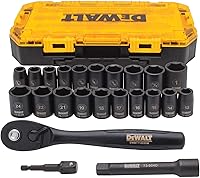
The DeWalt 23-piece 1/2 in drive set is identified as an impact socket set and includes SAE and metric sockets, an extension, a drill adapter and a quick-release ratchet.
Impact sockets do not replace all hand sockets. Keep the tool and socket pairing clear, and use the correct drive size for each job.
Which other tools are useful with a socket set?
A socket set works best when you have the right ratchet and accessories for the space and fastener. Add tools to solve a known access or leverage problem rather than filling a drawer without a plan.
A ratchet turns a socket through repeated short swings. If you cannot swing it freely, a smaller ratchet head, extension or universal joint may help reach the fastener, provided the combination is suitable for the job.
A breaker bar provides a longer handle for loosening fasteners by hand. It is not a ratchet, so don’t use one as a substitute when you need repeated turns in limited space.
Avoid using extra leverage on a ratchet unless its maker permits it. If a fastener will not move, check for the right tool, socket fit and direction before applying more force.
How can you keep a socket set organized?
Keep sockets sorted by drive, measurement system and size so you can find the right tool and return it to the same place. A case, tray or drawer insert can make missing pieces easier to spot.
Store metric and SAE sockets in separate rows if the markings are easy to confuse. Keep the ratchets and common accessories with the drive size they fit, and leave room to return each tool after a job.
The DeWalt set has hard-stamped socket markings and a removable inner tray. The Craftsman set stores its tools in a three-drawer case with a locking dial.
For a simple setup, see how to organize sockets so you can find them fast. The best organizer is one you can keep using after the first cleanup.
How do you choose a first socket set?
Choose your first set by matching it to one or two real jobs. Check the fastener sizes, measurement system, access and tool type before comparing piece counts.
Use this sequence:
- Write down the work you expect to do in the next few months.
- Check the fasteners and note their sizes and measurement system.
- Decide whether hand tools or an impact tool will do the work.
- Choose the drive size and socket depths that fit those tasks.
- Compare storage options and included accessories.
- Add specialty tools only when a job calls for them.
For basic vehicle maintenance, you may also want to review the tools needed for car repair. That guide covers tools beyond sockets, so you can plan a wider starter kit.
Which socket set approach fits your garage?
Choose a compact 1/4 in and 3/8 in set if you want a smaller hand-tool kit for common jobs. Choose a multi-drive mechanics set when you need broader SAE and metric coverage, extra tools and organized storage.
Pick a set with standard and deep sockets when fastener length varies across your work. Add an impact set only for compatible impact-tool jobs, and check its drive and intended use first.
Once you know which sizes you use most, keep those sockets easy to reach and expand the set around the jobs you actually take on. If your next task is wheel work, start with our guide to choosing a socket size for lug nuts.
Frequently asked questions
What should a home garage socket set include?
Start with sockets in the sizes that match your regular repairs, a compatible ratchet, and the correct drive size. SAE and metric coverage, shallow and deep sockets, and a storage case can make the set more useful.
Add extensions or a larger drive when a specific job calls for them.
Do I need both metric and SAE sockets?
You may need both, especially if you work on different vehicles, household equipment or older hardware. Check the fasteners you expect to handle before buying.
A dual measurement set can reduce the chance of reaching for the wrong size, but it may include sizes you rarely use.
What drive size should I get first?
Choose a drive size based on the fasteners and access in your usual work. A 1/4-inch drive can suit smaller fasteners and tighter spaces, while 3/8-inch is a flexible general hand-tool size.
A 1/2-inch drive is useful for larger sockets and jobs that call for more leverage.
Can I use regular sockets with an impact wrench?
Use impact sockets with an impact wrench. They are made for impact use, while ordinary chrome hand sockets are intended for hand tools and may not be suitable for the repeated hammering.
Check tool and socket compatibility before use, and wear eye protection.
Are more pieces always better in a socket set?
A higher piece count can add more sizes, drives, bits and accessories, but it does not guarantee that the set fits your jobs. Check which socket sizes are included, whether they are shallow or deep, the drive sizes and how the tools are stored.
Buy coverage you can use.