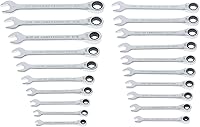
Flex Head vs Fixed Head Ratchet: Which Is Better? (October 2026)
Choose a flex head ratchet for angled access; choose a fixed head for a simpler, steady working position. The better fit depends on clearance around the fastener and whether the wrench head can stay aligned as you turn.
On this page (10 sections)
- Flex Head vs Fixed Head Ratchet: Which Is Better?
- Flex head vs fixed head ratchet: what is the main difference?
- When does a flex head help?
- When is a fixed head the better choice?
- Which head gives better access in tight spaces?
- Which style gives better control?
- How do you choose between flex and fixed?
- Can either style replace a socket ratchet?
- Which ratchet head should you choose?
- How we scored these wrench sets
Flex Head vs Fixed Head Ratchet: Which Is Better?
Choose a flex head ratchet when you need to angle around an obstruction; choose a fixed head when a straight approach works and you want a steady position. In the flex head vs fixed head ratchet choice, clearance and control matter more than the hinge alone.
A flex head pivots where the head meets the handle, letting you change the angle while the wrench stays on the fastener. A fixed head keeps that angle set, which can make the tool feel more direct in open space.
Both styles can ratchet, so you can keep turning without lifting the wrench after each short stroke. For how the ratcheting mechanism works, see how a ratcheting wrench works.
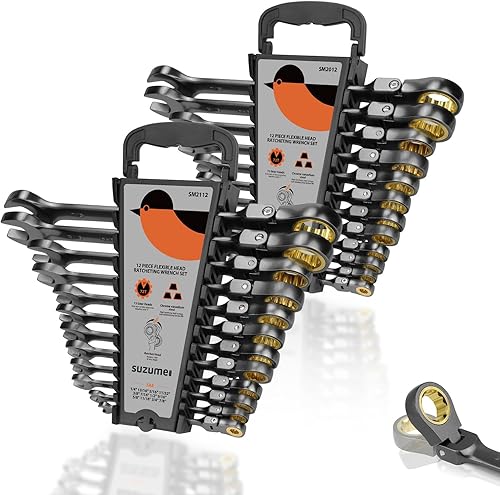 Best for broad metric and SAE coverage
SUZUME 24-piece flex head ratcheting wrench set
 Best for fixed-position SAE work
Klein Tools 8-piece SAE ratcheting combination wrench set
Flex head vs fixed head ratchet: what is the main difference?
A flex head pivots to give you more approach angles, while a fixed head stays in line with its handle. The pivot helps when nearby parts block a straight swing, but it adds a moving joint to manage.
With a fixed head, you choose the tool angle by repositioning the wrench and your hand. That can be straightforward when the fastener is open and the swing path is clear.
With a flex head, you can tilt the head to line up with a fastener that sits behind a hose, bracket or other obstruction. The head can also be harder to hold steady if the angle changes while you apply force.
Neither design guarantees that a wrench will fit. Check the fastener, the space around it and how far the handle must move before choosing a tool.
When does a flex head help?
A flex head helps when you can reach the fastener but cannot keep a straight wrench handle aligned with it. Its pivot can let the handle pass around nearby parts.
This is useful in a crowded engine bay, on machinery or around bike components when the fastener sits at an awkward angle. A SUZUME 24-piece set offers 180° pivoting heads and 72-tooth ratchets with a 5° working swing, along with metric and SAE sizes.
A WORKPRO 22-piece set also has 180° pivoting heads, with metric and SAE sizes from 6–18 mm and 1/4–3/4 in. It comes with a storage box for keeping the set together.
A flex head has limits. If the wrench head is pressed against a nearby surface, it may not have room to pivot, and the moving joint can make it harder to keep the wrench aligned.
When is a fixed head the better choice?
A fixed head is the better choice when the fastener is easy to reach and you want the head to stay in line with the handle. It has no pivot to position before each turn.
That simplicity helps when you have clear space around a fastener and can move the handle through a consistent arc. A fixed head can also make it easier to keep the wrench square on the fastener when the working angle is already comfortable.
The Klein Tools 8-piece SAE set has a fixed head, 90-tooth ratchet and pass-through capability for longer threads. Its sizes run from 5/16 to 3/4 in, so it suits jobs that use SAE fasteners.
A fixed head cannot bend around an obstruction. If a bracket blocks the handle or the head cannot sit squarely on the fastener, use a different angle or tool.
Which head gives better access in tight spaces?
A flex head can give better access when the fastener is reachable from an angle; a fixed head can work better when the space is tight but straight. Tight space does not always mean a pivoting head will fit.
Measure the room around the fastener, including the space the head needs to tilt and the arc the handle needs to travel. A flex head may solve a blocked approach but still need clearance around its hinge.
The ratchet tooth count also affects how little the handle must move between clicks. The Klein set has a 90-tooth ratchet, while the SUZUME and WORKPRO sets have 72-tooth ratchets.
Their stated working swing is 5°, which can help in confined spaces, though the wrench still needs room to engage and turn.
If the fastener is recessed, a socket may fit better than a wrench. Our guide to deep sockets versus shallow sockets explains how socket depth changes access.
Which style gives better control?
A fixed head offers a steady angle, while a flex head offers angle choice that you may need to manage as you work. The right choice depends on whether your hand can keep the tool seated and aligned.
A pivoting head is useful when a straight handle would hit nearby parts. Before applying force, check that the head is at a useful angle and fully seated on the fastener.
A fixed head avoids that extra positioning step. If the wrench fits squarely and the handle clears the work area, its set angle can feel more predictable.
Use a wrench size that matches the fastener. If the wrench rocks, slips or sits crooked, stop and check the fit rather than forcing a turn.
How do you choose between flex and fixed?
Choose by the fastener’s access path first, then compare the sizes and ratchet features you need. A wider set is only useful if it includes the sizes and head style that fit your work.
Ask yourself these questions before choosing:
- Is the fastener blocked from a straight approach? A flex head may help if the head can still pivot freely.
- Is the work area open? A fixed head may be simpler when the handle can move without hitting nearby parts.
- Do you use metric, SAE or both? SUZUME and WORKPRO include both standards; Klein's set is SAE.
- Do you need pass-through capability? The Klein set includes it for longer threads.
- Where will you keep the wrenches? SUZUME includes a handle-equipped rack, Klein includes a roll pouch, and WORKPRO includes a storage box.
If you're building out a wrench collection, compare these options with our guide to the best ratcheting wrench sets. It covers what to weigh when choosing a set for the jobs you do.
Can either style replace a socket ratchet?
A ratcheting wrench can handle many accessible fasteners, but a socket ratchet gives you more choice in socket depth and drive accessories. The tools overlap, but their heads and reach differ.
A wrench can fit where a socket and ratchet handle are too bulky. A socket can reach a recessed fastener or pair with an extension when the wrench cannot sit around it.
For lug nuts and other vehicle fasteners, first confirm the correct size and tool for the job. Our guide to choosing a socket for lug nuts can help with that specific task.
If a fastener is stuck, don't assume a flex head is the right way to add force. A breaker bar is designed for a different job than a ratchet.
Which ratchet head should you choose?
Pick a flex head if angle changes solve an access problem; pick a fixed head if the fastener is clear and a steady handle position matters more. For mixed home and vehicle work, choose the size range and storage that match your fasteners and workspace.
The SUZUME set offers the broadest size coverage here, with 24 metric and SAE pieces and 180° pivoting heads. WORKPRO gives you a 22-piece mixed-size set with flex heads and a storage box, while Klein focuses on 8 SAE sizes, a fixed head and pass-through capability.
Use the wrench that seats fully and gives you a clear, controlled swing. If neither head fits squarely, switch tools instead of forcing the fastener.
How we scored these wrench sets
Our scores weigh the listed features and size coverage against the access needs behind this comparison.
| Product | Best for | Head | Sizes | Ratchet | Our score |
|---|---|---|---|---|---|
| SUZUME 24-piece flex head ratcheting wrench set | broad metric and SAE coverage | 180° flex | 8–19 mm and 1/4–7/8 in | 72 teeth, 5° swing | 7.8 |
| Klein Tools 8-piece SAE ratcheting combination wrench set | fixed-position SAE work | Fixed | 5/16–3/4 in SAE | 90 teeth | 8.0 |
| WORKPRO 22-piece flex head ratcheting wrench set | a compact mixed-size selection | 180° flex | 6–18 mm and 1/4–3/4 in | 72 teeth, 5° swing | 8.2 |
Frequently asked questions
Is a flex head ratchet better than a fixed head?
A flex head ratchet is better when an obstruction prevents a straight approach to the fastener, because its head can pivot to a different angle. A fixed head is better when the fastener is easy to reach and you want a steady, simple tool position.
Neither style replaces checking clearance before turning.
Can a flex head ratchet be used like a fixed head?
A flex head can often be positioned in line with its handle, but whether it stays there depends on its design. Check the head before applying force and keep your hand clear of pinch points.
If you need a head that cannot pivot, choose a fixed-head wrench.
Does a flex head ratchet give more leverage?
A pivoting head changes the working angle, not the basic leverage of the wrench. Leverage depends on handle length and how force is applied.
Use a properly fitting wrench and avoid adding a pipe or other extension unless the tool maker allows it.
When should I use a breaker bar instead of a ratchet?
Use a breaker bar when a fastener needs a strong initial turn and the tool is designed for that load. A ratchet is suited to turning a fastener through repeated short strokes.
See our breaker bar versus ratchet guide for how the jobs differ.