Best Compact 1/4-Inch Socket Sets: How to Choose
A compact 1/4-inch socket set earns its place when it covers 4 mm to 15 mm and 5/32 in to 9/16 in without skipping sizes. Look for 6-point sockets, a fine-tooth ratchet, and a case that keeps the set organized in a drawer or bag.
On this page (9 sections)
- What does a compact 1/4-inch socket set actually cover?
- Why 6-point sockets matter more than the count
- How many ratchet teeth do you need?
- What should the case and layout do for you?
- Which compact set fits your work?
- How does 1/4-inch drive compare to 3/8 and 1/2?
- How do you set up and care for a compact socket set?
- Which compact socket set should you buy?
- How we scored these sets
A compact 1/4-inch socket set earns its place when it reaches the small fasteners a bigger drive cannot. The best compact 1/4-inch socket set for most people covers a full metric and SAE range in a single case, with 6-point sockets and a fine-tooth ratchet.
This guide explains what to check before you buy, and names the sets worth your money when a small drive is on your shortlist. The goal is simple: a set that stays organized, fits where you work, and covers every small hex head you meet.
Read on for the sizes, ratchet details and case choices that separate a useful kit from one that sits unused in a drawer. If your work runs bigger, our 1/2 drive socket set guide covers the heavy end of the drawer.
For a wider look at small drives, the 1/4 drive socket set roundup compares more options.
What does a compact 1/4-inch socket set actually cover?
A compact 1/4-inch socket set is built to cover small hex fasteners across both metric and SAE, not the big bolts a 3/8 or 1/2-inch drive handles. Expect shallow and deep sockets in the 4 mm to 15 mm and 5/32 in to 9/16 in bands, plus a ratchet and a case.
The compact label refers to the storage footprint and the drive size, not to a stripped-down socket list. A good set still includes the sizes you reach for most.
Metric sizes from 4 mm through 15 mm cover interior trim screws, hose clamps, battery terminals and most dash and console fasteners. SAE sizes from 5/32 in through 9/16 in cover older American hardware and mixed equipment.
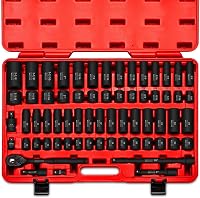
The set's case shape matters as much as the socket count. A blow mold case with a removable lid fits a tool chest drawer, while a flat case slides behind a seat or into a small bag.
Ratchet, extensions and a universal joint turn a box of sockets into a working kit. Without an extension you cannot reach recessed fasteners, and without a universal joint your angles are limited to straight on.
Decide the range first, then the storage. A set that skips the deep sizes you need sends you back to the store.
Why 6-point sockets matter more than the count
Six-point sockets grip the fastener's flats and are the default for 1/4-inch work. They resist rounding better than 12-point on worn or tight hex heads, and the small drive rarely needs the extra indexing points.
The count in the product name can mislead. Fifty-one pieces may include more sockets than a 56-piece set if one has extra accessories and the other adds deep sizes.
Look at what sits inside the count: shallow sockets, deep sockets, extensions, a universal joint, a spinner handle and a bit holder. A bit holder turns the same ratchet into a hex driver for trim screws.
Deep sockets matter more on a 1/4-inch set than on a big drive. Nuts on long studs, valve covers and sensor mounts need the depth, and a shallow socket will bottom out before it reaches the hex.
Radiused corners on a socket apply force to the flats rather than the corners, which helps on soft or painted fasteners. TEKTON calls this out on its set, and it is the same idea most makers build into 6-point sockets.
Weigh the sockets you need against the extras. A lean set with deep sizes beats a large set with none.
How many ratchet teeth do you need?
A 72-tooth ratchet is the sensible floor for a compact set, and 90 teeth or more makes tight work easier. Each added tooth shortens the swing arc before the pawl engages.
Swing arc is the reason. A coarse ratchet needs a wide sweep of the handle to click over one tooth, and a narrow gap under a dash may not allow it.
A 72-tooth head engages about every 5 degrees. A 90-tooth head engages about every 4 degrees.
GEARWRENCH's double-stacked pawl design is a different approach: it engages alternately on a 60-tooth gear to reach 120 positions, which is a finer arc again.
Head height and handle length also matter. A short handle fits confined spaces, while a longer one gives leverage on stuck fasteners.
A quick-release button lets you pop the socket off without pulling.
The ratchet's finish and grip affect comfort on long jobs. A knurled extension or handle gives a non-slip surface in oily hands, a detail worth checking on any kit you plan to use under a car.
Pick the finest ratchet you can afford inside your case footprint. In tight trim and dash work, the swing arc decides whether the job goes easily.
What should the case and layout do for you?
A good case keeps every socket visible, labeled and in its own slot, so a missing piece shows up at a glance. That is the real test of any compact set.
A blow mold case with a removable lid lets you lift the socket tray into a drawer and keep the lid for transport. A labeled storage case with size markings on each socket speeds up the search.
Stamped size markings are worth checking. A large, roll-stamped size on the socket's side stays readable after the chrome wears.
Printed labels fade.
Case footprint should match where the set lives. Measure the drawer or bag before you buy, then compare it with the case dimensions.
The GEARWRENCH set ships in a package 13.23 x 7.64 x 2.48 in, which fits most shallow drawers.
Lockable stacking cases and transparent lids help if you store several kits together. A removable internal tray lets you pull the working set without dragging the whole box.
Choose the case you will actually keep organized. A set that spills loose in a bag loses pieces fast.
Which compact set fits your work?
The right compact set depends on the job in front of you, not on the longest socket list. Match the set to your fasteners and your storage, then buy once.
For general home and auto work, a dual-standard set with deep sockets covers the widest ground. For tight trim and dash jobs, the ratchet's swing arc and a thumbwheel or spinner handle matter more than extra sizes.
For light engine bay work, a set with an extension and a universal joint reaches recessed bolts. For bike and small equipment work, a bit holder and a compact case matter most.
A three-quarter set of extra sizes you never touch is dead weight. Think about the last five small fasteners you turned, and check the set against them.
Write down your common sizes before you shop. The set that hits them all, with room to spare, is your set.
Here is how our three picks map to real work.
GEARWRENCH 51-piece: the tight-spot pick
The GEARWRENCH suits the buyer who works under dashes, inside doors and around cramped engine bay parts. Its 120-position ratchet and thumbwheel ratchet give two ways to turn a fastener where a full handle will not fit.
It covers 3/16 in through 9/16 in and 4 mm through 15 mm in both shallow and deep sockets, plus 2-inch and 6-inch extensions. The extensions carry a knurled grip for oily hands.
The thumbwheel ratchet is the standout for dash and trim work. You turn it with your fingers, which suits a fastener you can only reach one hand at a time.
Pick it when tight access is your main problem. The swing arc and finger drive give it an edge in cramped spots.
TEKTON 56-piece: the full-range pick
The TEKTON set suits the buyer who wants no skipped sizes and a case that marks every socket. It runs 5/32 in through 9/16 in and 4 mm through 15 mm with no gaps, in both shallow and deep sockets.
It adds a universal joint, a magnetic hex bit holder, a 6.5 in aluminum spinner handle and 3-inch and 6-inch extensions. The roll-stamped size markings stay readable along the socket's curved side.
Radiused corners apply force to the fastener's flats, which helps on soft heads. The exterior and interior are chrome-plated, with a clear coat or painted finish where needed.
Pick it when you want every size in one case and no gaps. The spinner handle and bit holder make it a fuller kit for mixed work.
DeWalt 25-piece: the light-duty pick
The DeWalt set suits the buyer who wants a compact, light set for occasional home and auto fasteners. Its 25 pieces cover 5/32 in through 9/16 in and 4 mm through 14 mm in standard sockets only, with a ratchet, a 3-inch extension and a drill adapter.
It packs into lockable stacking cases with a transparent lid and a removable internal tray. The drill adapter lets you drive a socket from a drill for light rundown work.
There are no deep sockets in this set, so nuts on long studs need a different kit. DeWalt backs it with a full lifetime warranty and says it exceeds ANSI specifications.
Pick it for light, occasional work and easy storage. Step up to a set with deep sockets if studded fasteners are part of your routine.
How does 1/4-inch drive compare to 3/8 and 1/2?
A 1/4-inch drive is for small fasteners, a 3/8 for mid-size work, and a 1/2 for heavy fasteners and impact use. The drive size sets the torque the tool can handle and the socket wall thickness.
A 1/4-inch ratchet is shorter and lighter, so it reaches into places a larger tool cannot. It also limits how much torque you can apply, which protects small fasteners from stripping.
A 3/8-inch set bridges the gap for suspension and engine brackets. A 1/2-inch set handles wheel nuts and larger bolts, and the 1/2 drive socket set guide explains that end of the job.
Impact work needs its own sockets. A standard chrome socket can crack under an impact wrench, and the impact socket set guide covers the thicker, heat-treated sets built for that.
A compact 1/4-inch set is a complement, not a replacement. Keep one in the drawer for trim and interior work and let the bigger drives take the heavy fasteners.
Own the drive that matches the fastener. Using a 1/4-inch set on a big bolt invites a rounded head and a stuck job.
How do you set up and care for a compact socket set?
A new set works best after you check the ratchet, oil the mechanism lightly and sort the sockets in their slots. A minute of setup saves a lost piece later.
Run the ratchet through a few turns before you trust it. Check that the direction lever clicks cleanly both ways and that the quick-release holds a socket firmly.
Sort every socket by size in its labeled slot. A missing size shows up when you need it most, so catch gaps early.
Wipe chrome sockets dry after use and keep the case closed in damp garages. A light film of oil on the ratchet head keeps the pawl moving freely.
The 120XP ratchet and other fine-tooth heads use a double pawl, so avoid forcing a stuck fastener with a cheater bar. Step up to a larger drive instead.
Replace a socket with a rounded or cracked opening rather than reusing it. A damaged socket spreads the damage to the next fastener.
Treat the set as a system. The case, the ratchet and the sockets all need care to stay useful.
Icon 1/2 inch socket set covers the larger ICON line if you need a mid-size companion.
Which compact socket set should you buy?
Pick the GEARWRENCH 51-piece if you work in tight spaces, the TEKTON 56-piece if you want every size with no gaps, and the DeWalt 25-piece for light occasional jobs. That is the firm rule, and it holds for most buyers.
Reach for the GEARWRENCH when the job involves dashes, door panels or crowded engine bay parts. The 120-position ratchet and thumbwheel handle the swing-arc problem that stops a coarse ratchet.
Reach for the TEKTON when the range matters more than the accessories. Every size from 5/32 in to 9/16 in and 4 mm to 15 mm is there in shallow and deep form, with a spinner handle and bit holder in the box.
Reach for the DeWalt when a small, light set for occasional fasteners suits your work. It is the leaner kit, without deep sockets.
That covers the compact 1/4-inch socket set choice from end to end. Match the drive to your fasteners, the range to your hardware and the case to your storage, then buy once and keep it organized.
How we scored these sets
Our score weighs specs, features and the job each set is built to do against what a compact 1/4-inch buyer needs. Range, socket count, ratchet teeth, accessories and case layout all count.
The GEARWRENCH leads on tight-space access with its 120-position ratchet and thumbwheel. The TEKTON scores on range and no skipped sizes.
The DeWalt scores lower for its smaller, standard-only socket list.
Scores are one number per product across the site, so the same set scores the same in every guide.
Frequently asked questions
Is a 1/4-inch socket set strong enough for lug nuts?
No. A 1/4-inch set suits small fasteners, interior trim, dash work and light engine covers.
For wheel nuts and suspension bolts, step up to a 1/2-inch drive set with the right wall thickness for impact use.
How many teeth should a 1/4-inch ratchet have?
More teeth mean a smaller swing arc before the ratchet engages, which helps in tight spaces. A 72-tooth head needs about 5 degrees of swing.
A 90-tooth head needs about 4 degrees, handy for confined fasteners.
Does a 1/4-inch socket set work on motorcycles and bicycles?
Yes for most light fasteners such as fairing bolts, brake lever clamps and accessory mounts. Check the socket range against the hex heads on your bike.
A magnetic bit holder lets you drive hex bits from the same ratchet.
Do I need both SAE and metric sockets in a compact set?
Choose both if you work on mixed equipment. A dual-standard set suits older American hardware and modern metric fasteners without a second box.
If you only touch metric vehicles, a metric-only set saves space.