Best Deep Socket Sets for Impact Drivers: How to Choose
Buy a deep socket set built for impact use in the drive size your driver can actually turn. A 3/8 inch set covers most engine, brake and trim work, while a 1/2 inch set handles lug nuts and larger fasteners with an adapter.
On this page (6 sections)
An impact driver deep socket set is the right buy when you need reach on recessed or long-threaded fasteners and want sockets that survive the driver's hammering. Start with a 3/8 inch set for everyday engine and brake work, and step up to 1/2 inch when lug nuts and larger bolts are on the list.
The tricky part is the connection. An impact driver uses a 1/4 inch hex chuck, not a square drive, so a square-drive socket set needs a hex-to-square adapter in the right size.
Get that link wrong and the set won't turn at all.
This guide walks through the choices that matter: drive size, deep versus shallow reach, steel grade, socket range and how to read a set's contents. Three sets are compared as examples at the end.
What drive size should your impact driver deep socket set use?
Match the drive size to the driver's torque and the fasteners you turn. A 3/8 inch drive set covers most work on cars and light trucks, while 1/2 inch sockets suit lug nuts and larger hardware.
An impact driver's 1/4 inch hex output is small, so the adapter is where the load lands. A 3/8 inch square drive is a natural step up from the hex chuck and keeps the adapter short.
A 1/2 inch drive needs more torque and a heavier adapter, so it fits better on high-torque drivers or when you use a dedicated impact wrench.
Think about the socket sizes you actually reach for. Brake caliper bolts, engine mounts and suspension nuts often sit in the 10–19mm and 3/8–3/4 inch range.
That band is the core of a 3/8 inch set. Lug nuts usually run 17–22mm or 13/16–7/8 inch, which pushes you toward 1/2 inch.
Deep sockets also change the length you handle. A 1/2 inch deep socket is longer and heavier, so balance and control matter more when you drive it.
If your work is mostly trim, interior and small engine fasteners, a compact 3/8 inch set is easier to steer into tight spots.
Pick 3/8 inch for everyday automotive work and 1/2 inch for lug nuts and heavy fasteners. The drive size you choose should match the largest socket you plan to turn, not the smallest.
Adapters, extensions and how the driver connects
An impact driver reaches square-drive sockets through a hex-to-square adapter. The adapter size must match both the chuck and the socket drive, so a 1/4 inch hex to 3/8 inch square adapter links a compact driver to a 3/8 inch set.
Extensions add reach but cost you torque and control. Long extension bars are useful down in engine bays and behind panels, but each joint flexes under the driver's pulses.
Use the shortest extension that clears the obstruction.
Universal joints and swivel sockets help around corners and awkward angles. A swivel lets the socket tilt to reach a fastener that a straight extension can't line up with.
Deep sockets already add length, so pair them with a swivel only when the angle demands it.
Check the set's included adapters before buying. A set that ships with a 3/8 inch female to 1/2 inch male adapter lets a 3/8 inch driver turn 1/2 inch sockets, but the torque still has to pass through that small link.
Choose a set whose adapters match your driver's chuck and your socket drive. An adapter that fits both ends keeps the whole set usable.
Deep vs shallow sockets: when the extra reach helps
Deep sockets reach fasteners on long threads and set down in recesses; shallow sockets fit tighter spaces. Pick deep when the nut sits below the surface or the stud sticks out past it.
Deep well sockets are the standard for spark plugs, brake caliper brackets and studs that run long. The extra barrel length lets the socket slide over the protruding thread and still seat on the nut.
A shallow socket would bottom out on the stud before it grips.
The trade-off is length. A deep socket needs more clearance above the fastener, so it can foul on a firewall, frame rail or tight engine bay.
Shallow sockets go places deep ones can't.
Many complete sets include both. The NEIKO 67-piece set carries 12 shallow and 12 deep metric sockets plus 8 shallow and 8 deep SAE sockets in 3/8 inch drive, so you can switch reach without changing sets.
That mix is handy when a job moves from a recessed nut to a tight bracket in the same session.
If your work is mostly long studs and recessed nuts, a deep-only set like the BOEN 35-piece covers the reach you need without paying for shallow sockets you won't use. If you work across many jobs, a set with both depths saves a second purchase.
Choose deep-only when reach is the whole job, and a mixed set when you handle varied fasteners. Deep sockets solve reach; shallow sockets solve clearance.
Socket range: metric, SAE or both
Socket range decides which fasteners you can turn. Metric sizes fit most modern cars and trucks, while SAE sizes fit older vehicles, lawn equipment and some household hardware.
Check the range against your vehicle before buying. A set that stops at 19mm leaves larger suspension and axle nuts uncovered.
A set that starts at 8mm handles small trim and bracket bolts but skips the bigger stuff.
The NEIKO set runs 8–19mm and 5/16–3/4 inch in both shallow and deep. That covers a lot of engine and brake work on cars and light trucks.
The BOEN 35-piece reaches 8–24mm and 3/8–1-1/4 inch in deep only, which pushes into larger hardware.
A set with both metric and SAE lets you work on mixed fleets and borrowed equipment without hunting for a second set. If you only touch one vehicle type, a single-standard set may be enough.
Pick a range that covers your largest fastener plus one size up. Buying short leaves you stuck mid-job.
What socket materials and markings should you check?
Look for impact-rated steel and clear size markings. Chrome molybdenum (Cr-Mo) handles repeated hammering and high torque, while chrome vanadium (Cr-V) is tough and common.
Deep sockets on an impact driver take hard pulses, so steel grade matters.
The BOEN 35-piece set uses heat-treated forged Cr-V steel and a black manganese phosphate coating for corrosion and rust resistance. The NEIKO 67-piece set uses Cr-V and Cr-Mo steel with a black phosphate coating.
The BOEN Pro 80-piece set uses Cr-Mo alloy steel throughout.
Steel grade is not the only sign of quality. Look for a 6-point hex design that grips the flats of the nut rather than the corners.
Six-point sockets spread force across six sides and reduce rounding under high torque. All three sets here use a 6-point design.
Markings matter when you're working fast. Laser-etched and stamped sizes stay readable after repeated use.
The BOEN Pro set uses embossed markings with yellow grooves for 1/2 inch sockets and green grooves for 3/8 inch sockets, so you can tell drive sizes apart at a glance.
Check the finish for corrosion resistance if the set lives in a garage or truck bed. Black phosphate and black manganese phosphate coatings both resist rust better than bare steel.
The BOEN 35-piece set may arrive with a light coat of anti-rust oil, which is normal protection rather than a defect.
Choose Cr-Mo for heavy impact use and Cr-V for lighter work, and always check for 6-point sockets and clear markings. Material and markings decide how long the set lasts and how fast you work.
How to read a set's contents before you buy
Count sockets by drive size and depth, then check the extras. A set's piece count includes sockets, extensions, adapters and joints, so the number alone doesn't tell you how many fasteners it covers.
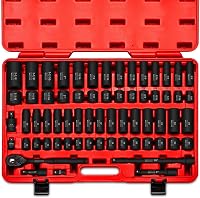
Start with the socket list, not the total. The NEIKO 67-piece set breaks down into 20 shallow sockets, 20 deep sockets, 20 swivel sockets, 3 extension bars and a ratchet, plus adapters.
That's 67 pieces, but the socket count you can actually turn is 60.
Check the drive size of each group. A set that mixes 1/2 inch and 3/8 inch drive sockets needs adapters to switch between them.
The BOEN Pro 80-piece set includes 1/2 inch and 3/8 inch drive sockets in deep and shallow, plus three adapters to bridge the sizes and a 1/2 inch 90-tooth ratchet handle.
Look at the extension lengths. Short bars reach nearby fasteners, long bars reach deep into engine bays.
A set with 2, 3 and 6 inch bars covers more jobs than one long bar alone.
Check the case or storage. A blow-molded case with double locks keeps sockets organized and protected.
A low-profile drawer liner fits in a tool cart and saves vertical space. The BOEN Pro 80-piece set uses a 24 x 16.7 inch drawer liner with a 1.6 inch profile.
Choose a set whose socket count and depths match your work, not the biggest piece count. Extras like swivels and long extensions earn their place only if you'll use them.
The 3 sets compared
These three sets show the range of deep socket options for impact drivers. Our score weighs specs, features and how well each set fits the buyer's job against what you're shopping for.
NEIKO 67-piece 3/8 inch drive impact socket set: best overall
The NEIKO set earns the top score because it covers the widest range of everyday jobs in one case. It's a 3/8 inch drive set with 67 pieces, including 20 shallow and 20 deep sockets in metric and SAE.
The metric range runs 8–19mm and the SAE range 5/16–3/4 inch. The set also includes 12 metric and 8 SAE swivel sockets, so you can work around corners without a separate purchase.
Three extension bars (2, 3 and 6 inch) cover short and long reach.
The 72-tooth ratchet handle adds hand-turning capability when the driver isn't the right tool. Cr-V and Cr-Mo steel with a black phosphate coating handle impact use.
Laser-etched sizes stay readable.
Pick this set for most people. It covers common automotive fasteners in both standards and gives you shallow, deep and swivel options in one case.
If your work is mostly lug nuts or heavy hardware, the 1/2 inch BOEN set below is the better fit.
For more options in this style, see our roundup of the best impact socket sets.
BOEN 35-piece 1/2 inch drive deep impact socket set: best for lug nuts and large fasteners
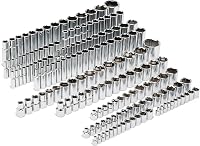
The BOEN 35-piece set scores second because it focuses on deep reach in 1/2 inch drive. It's the set to choose when your fasteners sit in recesses or on long studs and you need the larger drive size.
The deep socket range runs 8–24mm and 3/8–1-1/4 inch. That covers most lug nuts and larger suspension and axle hardware.
Three extension bars (3, 5 and 10 inch) reach deep into engine bays and wheel wells.
The set includes a 1/2 inch universal joint and a 3/8 inch female to 1/2 inch male adapter. The adapter lets a 3/8 inch driver turn the 1/2 inch sockets, but the torque still passes through that smaller link.
For heavy lug nut work, use a driver rated for the load.
Heat-treated forged Cr-V steel and a black manganese phosphate coating handle impact use. The double-lock blow-molded case keeps the set organized.
If you want a set with a ratchet included, see our guide to the best deep socket set with ratchet.
BOEN Pro 80-piece 1/2 and 3/8 inch drive impact socket set: best for a full workshop setup
The BOEN Pro 80-piece set scores third because it's the largest and most complete set here. It covers both drive sizes in deep and shallow, which suits a shop that works on many vehicle types.
The socket range runs 10–32mm in 1/2 inch drive and 8–24mm in 3/8 inch drive. It includes three socket adapters, two universal swivel sockets and two extension bars.
A 1/2 inch 90-tooth ratchet handle drives both drive sizes through the included adapter.
Cr-Mo alloy steel handles high-torque impact use. Embossed markings with yellow and green grooves separate the drive sizes at a glance.
The 24 x 16.7 inch drawer liner fits most 30 inch and wider cabinets and saves vertical space compared with a blow-molded case.
Pick this set when you want one kit for the whole shop. It covers the widest range and both drive sizes, but it costs more and takes up more drawer space.
For smaller budgets and simpler jobs, our roundup of the best socket sets for homeowners covers compact options.
For professional-grade alternatives, see our guide to the best professional socket sets.
How to match a deep socket set to your driver and your work
Start with your driver's torque, then choose the drive size and depth that fit the fasteners you turn most. A compact 1/4 inch hex driver pairs best with 3/8 inch drive sockets through a short adapter.
A high-torque driver can handle 1/2 inch drive.
Check the adapter first. The hex-to-square adapter is the weak link between the driver and the socket, so match its size to both ends.
A 1/4 inch hex to 3/8 inch square adapter is the most common pairing for impact drivers.
Then look at reach. Deep sockets solve long studs and recessed nuts.
If you also work in tight spots, a set with shallow sockets gives you options. A set with both depths covers more jobs without a second purchase.
Finally, check the socket range against your vehicle. Metric-only sets suit most modern cars.
Mixed metric and SAE sets suit older vehicles, lawn equipment and mixed fleets. The largest fastener you turn sets the top of the range.
Pick 3/8 inch deep for everyday automotive work, 1/2 inch deep for lug nuts and large hardware, and a mixed set for a full shop. Match the adapter to your driver and the socket range to your vehicle, and the set will earn its place in the toolbox.
Frequently asked questions
Will a deep socket set work with my impact driver?
Yes, if the set's drive size matches the driver's output and the set is rated for impact use. An impact driver has a 1/4 inch hex chuck, so a square-drive socket set needs a hex-to-square adapter to connect.
Do I need 3/8 inch or 1/2 inch deep sockets for an impact driver?
Choose 3/8 inch for most engine, brake and trim fasteners, and 1/2 inch for lug nuts and larger bolts. A 3/8 inch set turns faster on a compact driver, while 1/2 inch sockets need more torque and a sturdier adapter.
Are Cr-V or Cr-Mo sockets better for impact drivers?
Cr-Mo steel handles repeated hammering and high torque better, which matters for deep sockets on an impact driver. Cr-V sockets are tough and common, but Cr-Mo is the safer pick when the driver delivers hard pulses.
What is the difference between a deep socket and a shallow socket?
A deep socket reaches nuts on long threads and fasteners set down in recesses, while a shallow socket is shorter and fits tighter spaces. Deep sockets add reach but can be too long for confined areas.
Can I use a deep socket set for lug nuts?
Yes, but choose a set whose drive size and socket range cover your lug size. A 1/2 inch deep impact set covers most lug nuts, and a 3/8 inch set can handle smaller vehicles with the right adapter.